
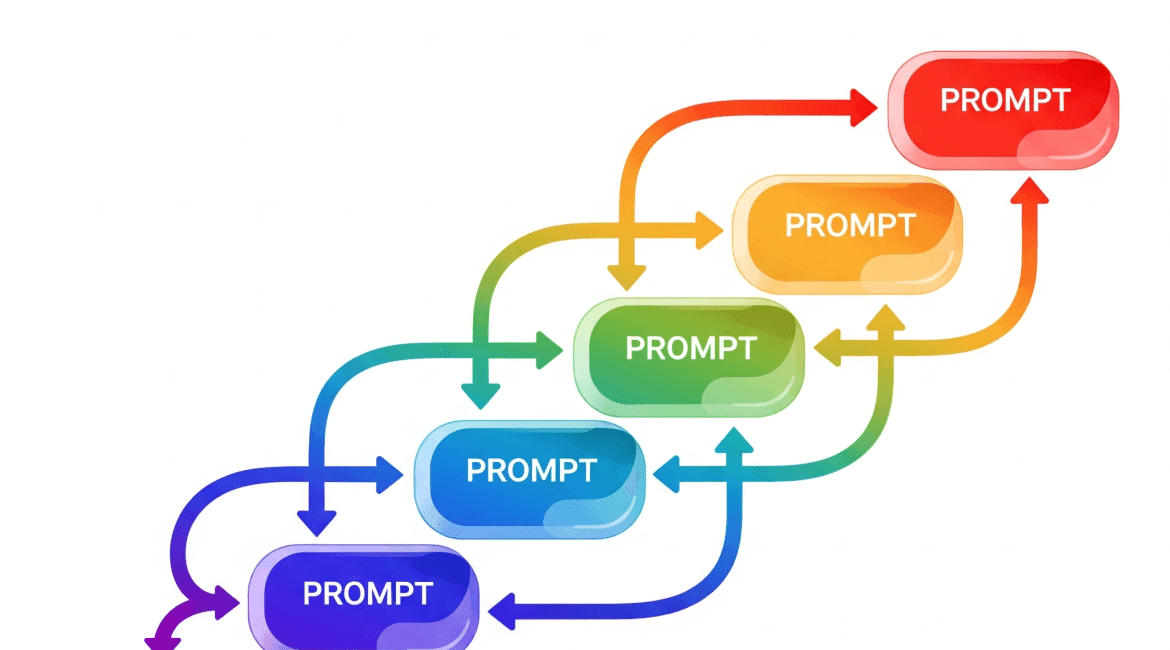
Prompt Chaining: Orchestrating AI for Complex Tasks and Workflows
You’ve learned how to craft a stellar individual prompt, refine AI output through iteration, and even leverage follow-up questions for deeper conversations. But what happens when your goal is truly massive? What if you need AI to perform a multi-stage project, like developing an entire marketing campaign from research to ad copy, or drafting a comprehensive business plan? This is where the advanced technique of prompt chaining becomes indispensable.
Prompt chaining is the art of breaking down a complex, multi-step task into smaller, manageable sub-prompts, where the output of one prompt becomes the input (or context) for the next. It’s like orchestrating a symphony, guiding the AI through a series of actions to achieve a grand, cohesive result. This powerful method allows you to tackle projects that would be impossible with a single, monolithic prompt.
Why Orchestrating with Prompt Chaining is a Game-Changer
Trying to get AI to do everything at once for a big project often leads to generic, overwhelming, or incomplete results. Prompt chaining overcomes these limitations by:
- Handling Complexity: Breaking down daunting tasks into digestible, sequential steps.
- Ensuring Precision: Focusing the AI on one specific part of the project at a time, leading to higher quality for each component.
- Maintaining Cohesion: Building context from one step to the next, ensuring the final output is unified.
- Boosting Efficiency: Minimizing manual editing by guiding the AI more effectively through intricate processes.
- Unlocking New Possibilities: Enabling the creation of entire workflows that mimic human project management.
While it’s an advanced technique, prompt chaining relies heavily on the core fundamentals covered in our AI Prompt Fundamentals Guide, making your foundational knowledge incredibly valuable.
The Prompt Chaining Process: A Step-by-Step Approach
Think of prompt chaining as a systematic flow:
Define the Grand Goal: Clearly articulate the entire, complex task you want to achieve.
- Example Goal: Create a complete content strategy for a new e-commerce fitness brand.
Break it Down (Decomposition): Divide the grand goal into logical, sequential sub-tasks. These will become your individual prompts.
- Sub-tasks:
- Audience research summary.
- Competitor analysis summary.
- Content pillars generation.
- Topic idea generation for each pillar.
- Blog post outline for one topic.
- Sub-tasks:
Execute & Iterate Each Link:
Prompt 1 (Audience Research): “Act as a market researcher. Analyze trends in the fitness e-commerce space and summarize the key demographics and psychographics of potential customers for a brand selling high-performance activewear. Provide 3-5 bullet points.”
AI Output 1: (Audience Summary)
Prompt 2 (Competitor Analysis – using Output 1’s context): “Based on the audience summary you just provided, identify 3-5 key competitors in the high-performance activewear market. For each, briefly outline their unique selling propositions (USPs) and content strengths/weaknesses. Format as a table.”
AI Output 2: (Competitor Analysis Table)
Prompt 3 (Content Pillars – using Output 1 & 2’s context): “Considering the audience and competitor analysis, propose 3-4 strategic content pillars for a new e-commerce fitness brand specializing in high-performance activewear. Each pillar should be distinct and appeal to the target demographic. For each pillar, provide a brief rationale.”
AI Output 3: (Content Pillars with Rationale)
And so on… You continue this process, feeding the relevant previous output (or parts of it) into your next prompt. This is a highly structured form of iterative prompting.
Best Practices for Effective Prompt Chaining:
- Start with a Clear Vision: Know your end goal before you begin chaining.
- Modular Prompts: Each individual prompt in the chain should be focused and achievable on its own, utilizing principles like clarity and conciseness.
- Explicit Context Passing: Always refer back to the previous output. Phrases like “Building on your last response,” “Based on the [X] you just generated,” or “Using the information from step [Y]” are crucial.
- Review Each Step: Don’t just blindly chain. Review the output of each prompt before feeding it into the next. If a step is off, fix it with follow-up prompts before moving on.
- Manage Context Window: For very long chains, you might need to summarize previous outputs before feeding them into new prompts to stay within the AI’s context window limits.
Prompt chaining elevates your AI interaction from simple queries to sophisticated project management. By learning to orchestrate AI’s capabilities step-by-step, you unlock the power to create incredibly detailed, high-quality, and comprehensive outputs for even the most complex tasks.
Ready to conduct your AI symphony and tackle workflows like never before? Our AI Prompt Fundamentals Guide provides advanced strategies, detailed examples, and frameworks for mastering prompt chaining and all other essential prompt categories, transforming your AI interactions into a powerful, organized engine for content creation.


